
BEYOND CLEANING: PLASTICS
Kärcher uses recycled plastic in the manufacture of its products: in 2026, we are using recycled plastic made from processed plastic waste in the plastic parts of more than 80 products and in the packaging of 160 detergents.
Our aim is to gradually increase the use of recycled plastics across our product range. As part of the “Beyond Cleaning: Plastics” initiative, participating products specifically help to reduce the use of virgin plastic. Products that are part of the “Beyond Cleaning: Plastics” initiative are listed at the end of this page.
Development of the Proportion of Recycled Plastics
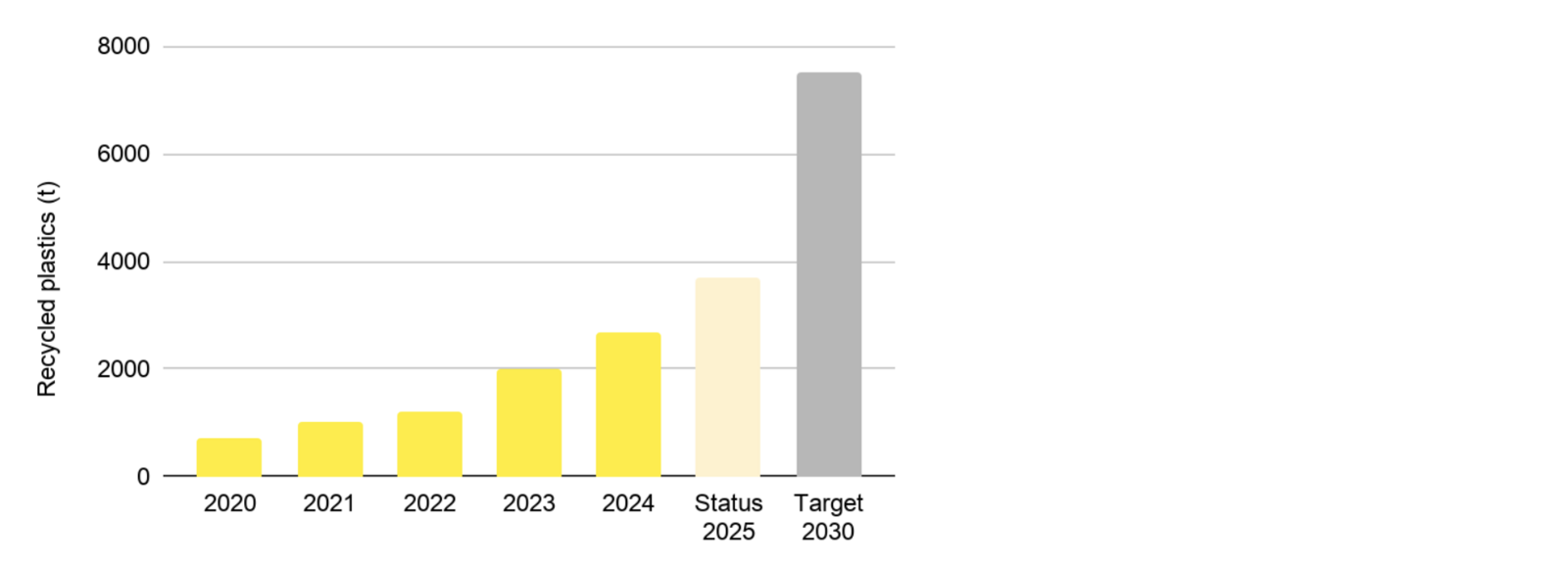
Since 2018, we have steadily increased the use of post-industrial and post-consumer recycled plastic. We use these materials for the plastic parts of our machines and for cleaning-product packaging. In 2025, Kärcher used 3,765 tonnes of recycled plastic – 41 per cent more than in the previous year. This means that recycled plastics accounted for 6.7 per cent of the total amount of plastic used.
For every new product development, we assess the technical suitability of recycled plastics made from processed plastic waste and develop suitable solutions through to series production. Every product and component containing recycled material makes its own contribution to the “Beyond Cleaning: Plastics” initiative. Together, these products and components help to reduce our consumption of virgin plastic resources.
Through the use of various recycled plastics across our product portfolio, the associated emissions in 2025 were calculated to be 3,833 tonnes of CO2e lower than they would have been had the same quantity of plastic been produced from virgin plastic1. The difference results from the fact that, for the material categories considered, producing recycled plastic requires less energy and therefore generates lower CO2e emissions than producing virgin plastic.
1Compared with production using 100 per cent virgin plastic. Based on the total purchased quantity of recycled plastic (material flow analysis). The emissions calculation is based on ecoinvent (version 3.12) and takes into account material-specific emission factors (market-based). For material categories without specific datasets, corresponding reference factors are applied.
Our Future Goals
As part of our 2030 Sustainability Strategy, the “Driving Circularity” initiative aims to continuously increase the use of recycled plastics in production and packaging.
DISCOVER MOREExpert Knowledge About Recycled Plastics
According to ISO 15270, recycled plastic refers to plastic material obtained from the recycling of plastic waste. To classify recycled plastics, Kärcher uses DIN SPEC 91446 as a basis.
Post-industrial recycled plastic (PIR) generally refers to plastic waste generated during industrial production processes. As its composition is often known, this waste can in many cases be specifically sorted and processed. This makes it easier to control the material quality.
The post-industrial recycled plastic used by Kärcher is sourced from external suppliers and consists of plastic materials that have been professionally prepared. Kärcher’s own production residues are not included in the recycled quantities stated here. If such residues are reprocessed, Kärcher refers to the resulting material internally as regranulate. This material is not included in the calculation of recycled quantities.
Post-consumer recycled plastic (PCR) is obtained from plastic waste discarded after use. This waste is sorted, cleaned, shredded and processed into plastic granules. Because the input materials vary, achieving consistent material quality is more challenging.
Depending on its intended use, recycled plastic – like virgin plastic – must meet defined requirements, such as elongation at break, robustness, leak-tightness and stability. For Kärcher, it is also essential that the function, safety, durability and repairability of its products are consistently ensured, regardless of the material selected.
At Kärcher, materials are tested in the materials laboratory before being approved for use in product development. As of August 2026, Kärcher’s materials database contains more than 1,000 variants of recycled plastic. This enables Kärcher to identify and select suitable materials for new product developments.
Kärcher calculates the proportion of recycled material by weight in accordance with DIN EN 45557. The calculation covers all plastic parts; accessories are not included. The precise basis for the calculation is explained to customers in a corresponding note.